
The olive harvest and the oil production in Liguria in the old days.

Updated: Mar 14
When the olive was ripe, as early as the end of October, but generally only in November or December, the harvest began: provided that it was a dry day without dew. A first method, far preferable because it prevented the olives from bruising, was to collect them by hand. For this use there were, and still are now, special ladders, with a lot of space between the rungs. This way the collector could give himself more balance by folding a leg over a rung and holding on behind the rung below with his foot.

The olives collected were placed in a sack carried over the shoulder or in bags. The experienced farmer held the branch with one hand, and with the other he collected the olives as if pruning it. Many farmers now no longer have the trouble of picking fruit carefully by hand but they bite the branches with poles when olives are ripe to the point of immediately detaching themselves from the branch.
This process, which has spread more and more, due to the lack of manpower, has two disadvantages: the fruit, already very ripe, dents and often loses a little bit of its oil; in addition, the thin twigs of the year, which will provide the harvest for the coming year, are damaged,.

After the harvest, the children passed under the trees to glean the fallen olives in the baskets. Now the beating down method, is performed by previously spreading canvases under the trees in order to facilitate harvesting. The fallen olives are then collected in big plastic baskets, and still nowadays it is often the children who take care of this.
In the past the containers for the collection of the olives were handmade baskets in wood or chestnut fiber, carried on shoulders and called “cuffe”.


After the harvest, the olives were spread out in thin layers on a wooden floor to continue to ripe, or inside large sieves from which they could be further cleaned from leaves, soil or rotten fruits.
Usually olives were defoliated by hand from the moment of the harvesting, being careful not to include the leaves during the collection in the baskets, but, by placing the freshly picked olives on large square sieves, they were able to spread them and identify the possible remained leaves to be eliminated. The sieves also had the function of aerating the olives, which in case of humidity could dry and not create rot before pressing. After fifteen days they were ready to be ground.
With the help of neighbors and friends, they were taken to the press, carried in the quarters, a type of wooden barrel with a fixed capacity (12 kilos of olives). Twelve quarters were expected to yield 144 kilos of ground olive paste.
Wood was also brought to heat large cauldrons.

Once at the mill, the olives were thrown into the hopper, a wedge-shaped wooden crate with a hole in the bottom. Behind it was the grindstone which, placed on the base of the press (also made of stone and often edged with slate slabs), turned slowly around a vertical axis, and was pushed in most cases by force animal. The grinding wheel passed over the olives and crushed them. It took a good half an hour to make a first grinding, then the grinding wheel was passed over the obtained olive paste, with the help of a "vottazza" (a wooden scoop) to put the overflowing paste (U pestu) along the way of the grinding wheel.

The resulting pomace was then thrown into the cauldron, a large walled copper tub located in another side of the room. A slow fire was made under the cauldron to heat the pomace and soften it, then it was handled or stomped with the feet inside the cauldron itself. Once ready, it was moved on to pressing phase.The olive press was the same used for grapes, but while the grapes were placed directly in the press cage, the paste of the ground olives was placed in flat and circular bags of rope or hemp (called zerbin). These discs filled with lukewarm pomace were stacked inside the press vertical supports, interspersed with square or cylindrical wooden blocks placed on top of them (called sepi).

Once the logs were put into the press, the twisting began by turning the shaft that moved the nut screw. The more the circular bags were squeezed the lower they got and it was necessary to put more blocks on top.

It was also possible to make two or three further pressings after emptying the discs and softening the pomace with lukewarm water, to the detriment of the quality of the oil obtained.
The squeezed oil mixed with water was channeled and collected in a container (u Tinelu) placed in the hole in front of the press called "trogiu".
It was easy to recover the oil, of greater density than the water, because it kept afloat and therefore it was enough to tilt the container to pour the oil into other containers. The remaining part of the oil that surfaced on top of the water was skimmed. Finally the water remained with the scum (the deposit on the bottom), which was thrown away. Sometimes, however, the oily sediment which was recovered on the bottom of the good oil was kept and used make rough soaps.
The pomace obtained after the last squeezing was also recovered and reused as an ingredient for making focacce or as feed for animals (pigs and chickens), or again, dried, as fuel.

The good, edible oil was finally stored in ceramic containers of various capacities, called “Olle” (named after the ancient Iron Age ceramic vessels discovered in archaeological excavations in Chiavari) or jars. These rounded containers had wide bellies and narrow necks, were glazed yellow both inside and at the neck. As a lid the farmers themselves provided the jars with a wooden stopper on top, or a slate slab, that served as a lid. These containers were excellent for keeping the olive oil in the dark and at a constant temperature.
The jars were then stored in cellars, underground warehouses, or stone rooms inside the olive mills, away from heat sources and sunlight, which would have deteriorated the delicate, sweet flavor typical of Ligurian olive oil.
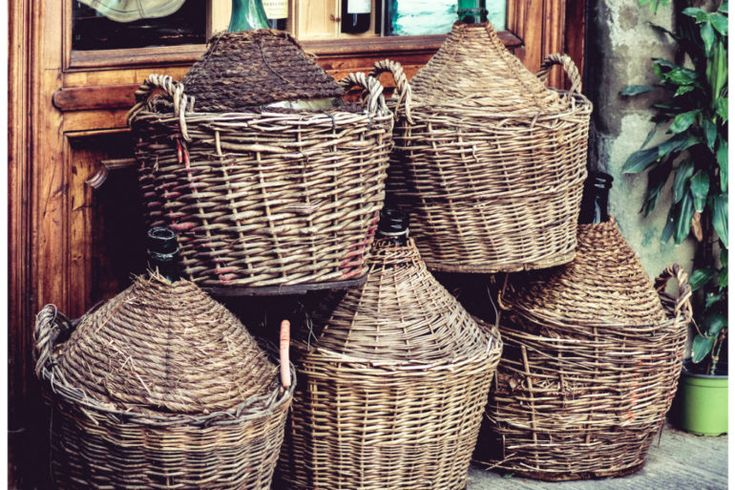
Another commonly used container for collecting olive oil was the dark glass demijohn with its two-handled basket, especially convenient for transport. These too were stored as needed, always to keep the olive oil in a dark place and protected from temperature changes.
Once the pressing period ended, all those who participated and worked to it, gathered and enjoyed a hearty meal based on stockfish and new wine.


Comments