
The modern Olive oil extraction in Gulf of Tigullio area

Updated: Feb 16
The veraison stage, or the moment in which the olives change color and from green become purple, is the key moment for harvesting olives for oil.


The operation can be divided into three / four main phases: milling or crushing, kneading (essential for the "continuous" method), pressing and water /oil separation.


Milling or Crushing - After being harvested, the olives are first stored for no more than 24 hours and then placed on a conveyor belt. Then, using a defoliator, all the leaves and branches are removed. In this second phase, the olives are washed by immersing them in tanks of water or in special washing machines, after which they are dried by simply draining the water.
In the past, olives were defoliated by hand, being careful from the moment of harvesting not to include the leaves, or by placing the freshly picked olives on large square sieves, so as to be able to spread them and identify the leaves to be eliminated. The sieves also had the function of aerating the olives, which in case of humidity could dry and not create rot before pressing.
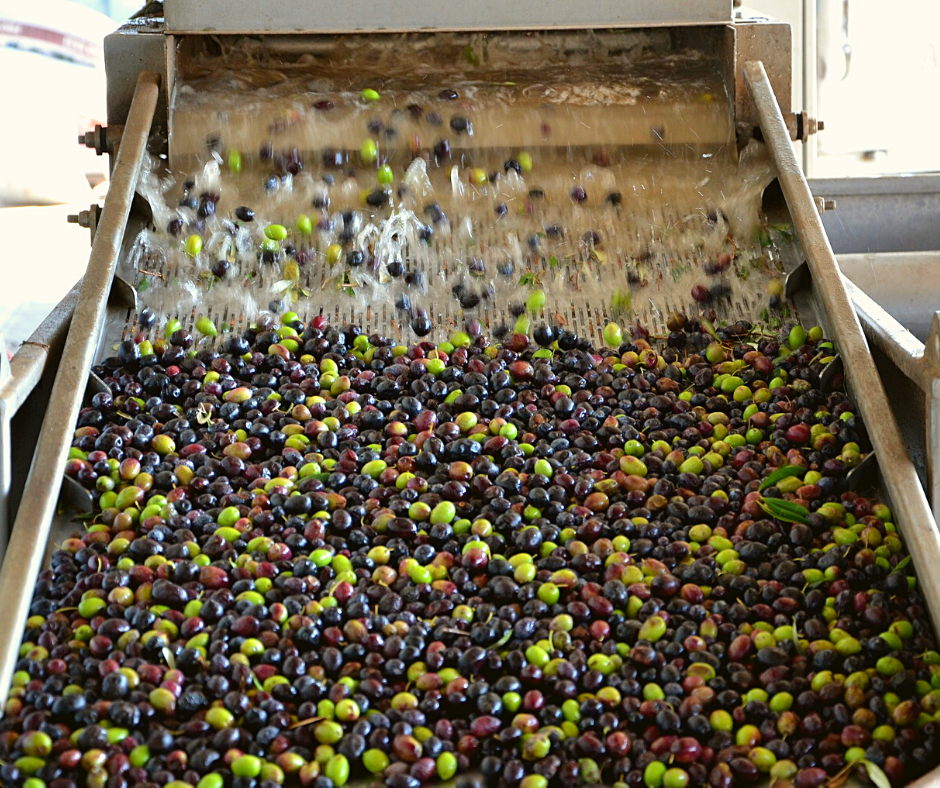
Milling or Crushing (Frangere in Italian, hence the name frantoio -Press) literally means to break: in this phase, in fact, the pulp and the pit of the olives are deeply torn through the mills (the old mill with stone wheels) or the modern hammer crushers. The result is an olive paste made up of pulp and pit, both crushed. Therefore, traditional technology uses granite millstones, i.e. wheels that turn on a (flat) slab also made of granite, crushing the olives with their weight. The modern method, on the other hand, uses hammer or rotary disc crusher, which quickly crushes the olives until the obtained paste comes out of the crusher through a perforated grate.
When the olive pit is broken, all the enzymes that influence both positively and negatively the quality of the final product are activated. In the first case, these are all those enzymes responsible for the extraction of all the volatile substances, linked to the aroma and which give the fruity scent, and for the extraction of the polyphenols that give the bitter and spicy taste, three positive and essential attributes to be found in the organoleptic analysis; on the other hand, all these enzymes of a negative nature can also be activated, responsible for the oxidation of the lipids with consequent deterioration of the quality of the product.
Certainly with the modern hammer crushers the granulometry of the solid part (pit) is more uniform than the pasta obtained with traditional grinders. In fact they crush a greater quantity of olives in the unit of time, but, as they tear the olive pulp too quickly, they also produce a sudden increase of temperature in the paste, and consequent alteration of the organoleptic sensations, such as bitterness and spicyness (much more pronounced). In case of using granite wheels, instead the disadvantage lies in the low working capacity.
Kneading - It consists of a continuous and prolonged mixing of the olive paste coming from the pressing. This favors the union of the oil droplets in larger and larger drops, such that these separate more easily in the following phase from the solid part. In the case of the use of mechanical crushers, this phase is indispensable as it must favor the breaking of the water-oil emulsions, formed during the rapid pressing. Furthermore, by subsequently using the modern extraction method, it is also inevitable to have to heat the pasta to a certain temperature. The old plants operated at higher temperatures, around 40-45 ° C, while the new ones work at lower temperatures, around 28-30 ° C. This is why this method is also called "hot"; unlike the traditional pressure method, where there was no heat given to the paste.

Pressing (liquid / solid separation) - Once the olive paste is ready, the actual extraction phase is carried out, which leads to the separation of the paste’s three components, namely pomace, vegetable water and oil. There are various methods for reaching the finished product, but broadly speaking they can be traced back to two large groups, based on the discontinuous or continuous nature of the operation. The first group includes the most traditional systems of extraction by mechanical pressure: the paste is placed on vegetable fiber disks (called “fiscoli”in Italian, which today are more often made of synthetic materials). Then the disks are stacked on racks and interspersed with steel discs (in the past they were in wooden ones) for to uniform pressure. Subsequently, the loaded rack is placed under the press, where the pressure, growing over an hour, causes the oily liquid component to drop out (the oily must, a mix of oil and vegetation water). The solid part that keeps squeezed after pressing is pomace. This is an excellent fuel, and still contains from 5 to 8% of oil, which can be separated only by the use of particular solvents, especially hexane, with a process similar to that used for seed oils.
Continuous methods, now mostly used, have replaced the pressure one by other physical principles. The main extraction system is based on centrifugation with the help of a decanter, and takes advantage of the different specific weight of the individual components. In fact, the olive paste is put into large centrifuges, but first it is also necessary to thin it with the addition of running water (always at the same temperature as the olive paste). The high speeds reached in the decanter lead to the separation of the three components: oil, vegetable water and pomace. Another method is percolation which instead relies on the different surface tension between the oil and the vegetation water; in the rhythmic immersion of stainless metal sheets in the olive paste, the liquid that adheres to their surface is gradually collected. With this system only a small percentage of the oil contained in the olives is extracted. The remaining part is separated from the peel and kernel residues in a centrifugal system (decanter).

Vegetable oil / water separation - This is the last step. Using the different specific weight (the oil is lighter than water) it is therefore possible to separate the oily must. The oil obtained is not perfectly transparent, but slightly cloudy, opaque. It is perfectly edible, raw and gives off a very intense aroma of olives, however it is preferable to leave it to rest for a few months, so that it can settle. The foreign substances are thus deposited on the bottom, producing small traces of "impurities". These are nothing but tiny particles of water.
Finally, the freshly pressed olive oil is stored in stainless steel containers. In modern mills, stainless steel has become the material of choice for short- and long-term professional storage, ensuring hygiene, light resistance, and the absence of foreign flavors. Although stainless steel is now predominant, the fundamental requirement remains to keep the oil in a dark, cool environment (15°C - 24°C) to preserve its fragrance.

Isola di Borgonovo cooperative and its olive mill inland of Chiavari
The Isola di Borgonovo Rural Agricultural Cooperative, in the municipality of Mezzanego, was established on July 27, 2005, with the primary objective of promoting local products, particularly the production of premium extra virgin olive oil. The cooperative, or grouping of farmers, is closely linked to olive growing and land management in eastern Liguria. Isola di Borgonovo is no exception, but its operations are forward-thinking, reviving a traditional and local dimension. Moreover, Mezzanego, in the Sturla Valley, is part of the rural Genoese territory that overlooks the Tigullio Gulf and has lived its history in the shadow of the Fieschi family of Lavagna. Among the various types of olive oils produced, there is the Riviera del Levante DOP certified extra virgin olive oil, extracted from olives harvested in olive groves managed by the Cooperative and supplied by its members. It is composed primarily of Lavagnina olives. In this sense, the social initiative of linking olive production to the emotional appeal of the possibility for customers to "adopt an olive tree" on the reclaimed land stands out. Customers, but it would be better to say "friends," because the relationship between people and the land, is what most involves the Cooperative's work. And this context also includes those who visit, collaborate, purchase, and appreciate. The Riviera Ligure-Riviera di Levante DOP olive oil is certainly an important milestone achieved by this small Cooperative.


Comments